

Off-grid cabin
An off-grid cabin has to supply what a utility connection normally would: power, water, heat and a way to deal with waste. This guide takes them one at a time.
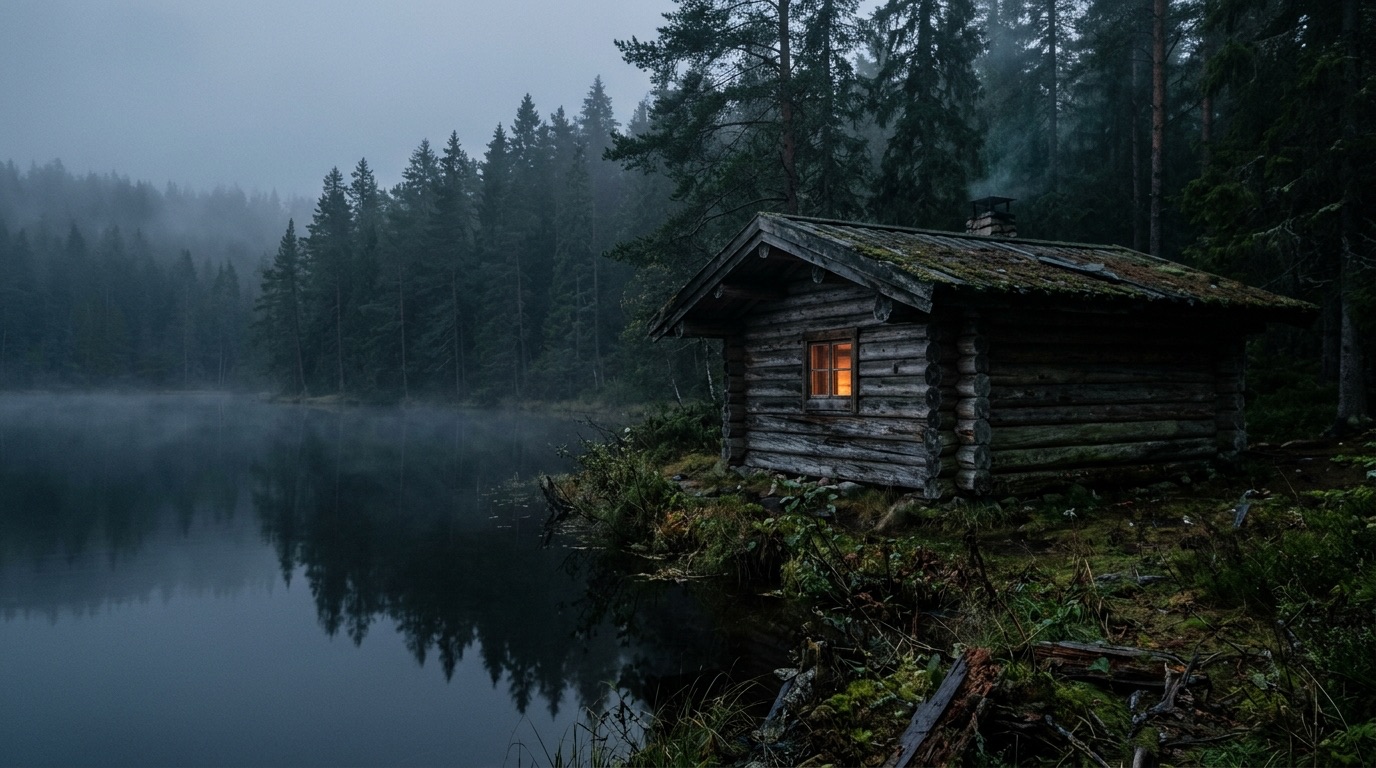
Off-grid is less a style of cabin than a list of four problems. Solve them in the right order and a small cabin is comfortable. Leave one out and you will notice it the first night.
The four are heat, power, water and waste. A utility connection normally hides all of them behind a meter and a monthly bill. Without one, each becomes a small system that you choose, install and look after yourself. None of them is complicated. What catches people out is the sizing, and sizing starts with the building.
- AThe shell. Insulation and air-sealing come first. They shrink every system below.
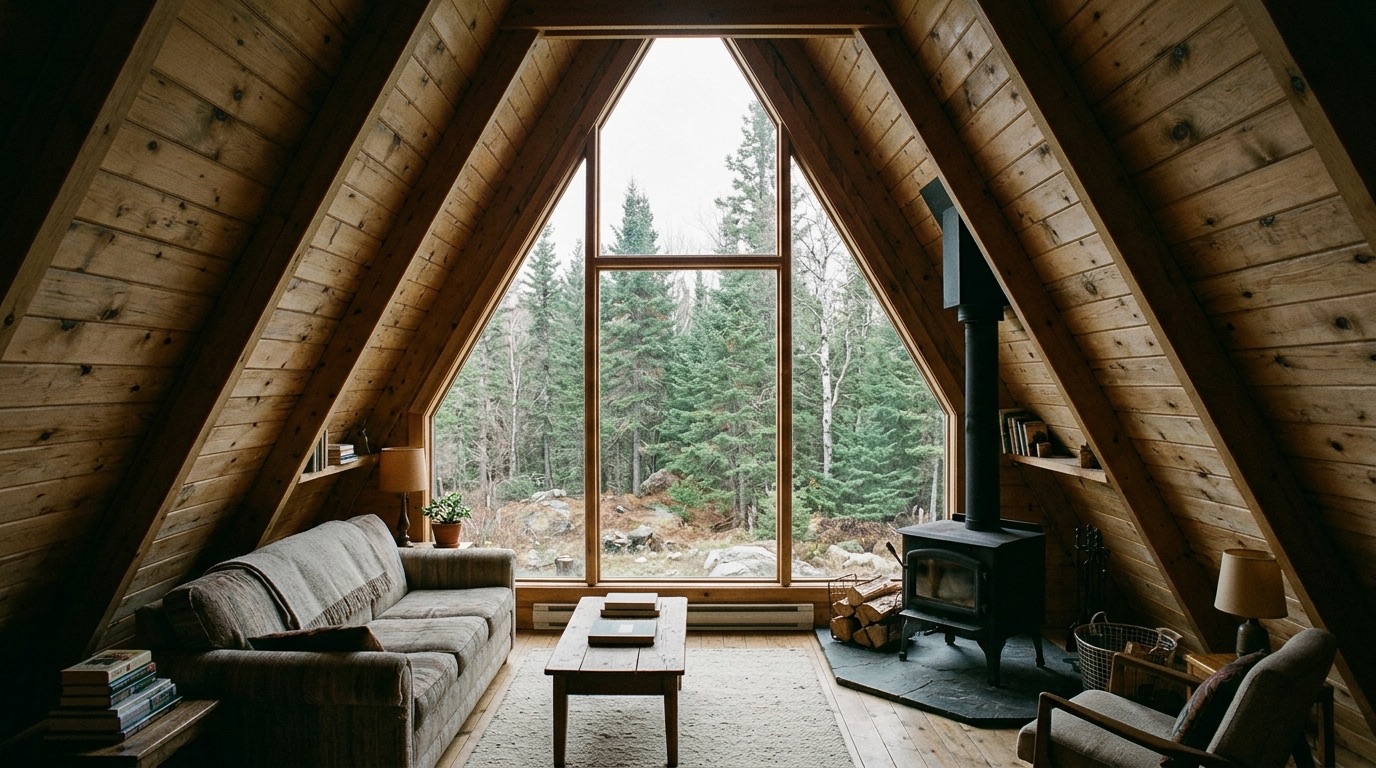
- BHeat. A small wood stove near the centre, with a straight chimney through the roof.
- CPower in. Solar panels on the slope that faces the midday sun.
- DPower stored. Battery, charge controller and inverter, indoors and close together.
- EWater. A tank filled from the roof, a well or a lake, piped in through a filter.
- FWaste. A composting toilet with its own vent, or a pipe out to a septic system.
Start by needing less
Every system gets simpler when the cabin is small and well insulated. A compact plan with a tight shell needs a smaller stove, fewer panels, a smaller battery and less of everything else. Each of those is something you would otherwise have to buy, carry in and maintain.
So the first off-grid decision is the plan. Choose the smallest one that does the job. The off-grid collection gathers the plans drawn with this in mind, and most of them are also in the tiny or small collections.
Insulate and seal before you size anything
Heat leaves a cabin two ways: through the walls, roof and floor, and through gaps. Insulation deals with the first. Air-sealing deals with the second, and it is the cheaper of the two. Tape the sheathing joints, seal around windows and doors, and close every hole where a pipe or wire goes through.
Do not forget the floor. A cabin on piers has cold air moving under it all winter, so the floor needs insulating as carefully as the walls. The roof matters most of all, because warm air rises and the ceiling is where it tries to leave.
Face the sun
Orientation is free. In the northern hemisphere, a roof slope that faces roughly south gives solar panels their best day. Windows on the same side let low winter sun warm the room. Keep the north side plainer, with fewer and smaller openings.
Look at the trees before you fix the position. A spot that is sunny in July can be in shade all day in December, when the sun is low and you need the power most.
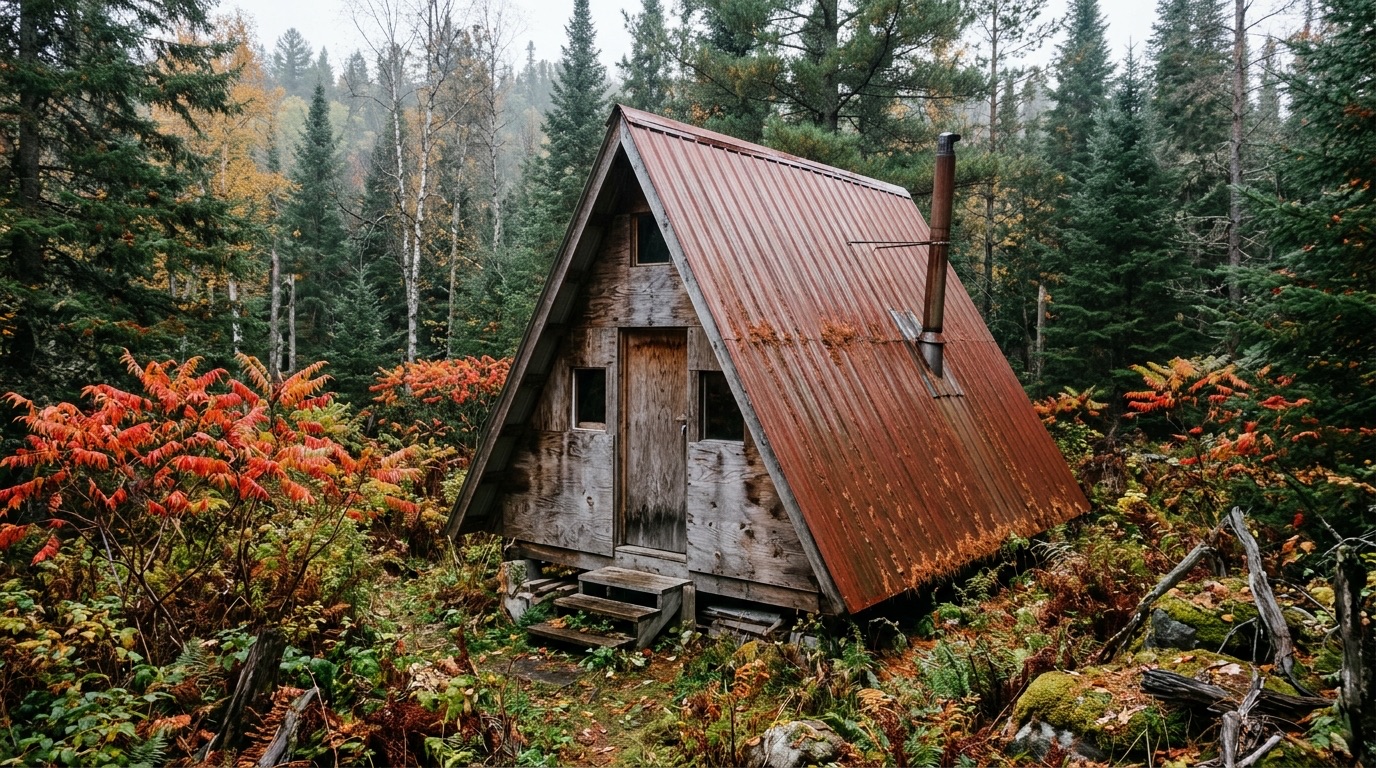
The Sumac
- Footprint
- 12 × 20 ft
- Floor area
- 240 sq ft · 22.3 m²
- Beds / baths
- Studio · no bath
- Loft
- Sleeping loft
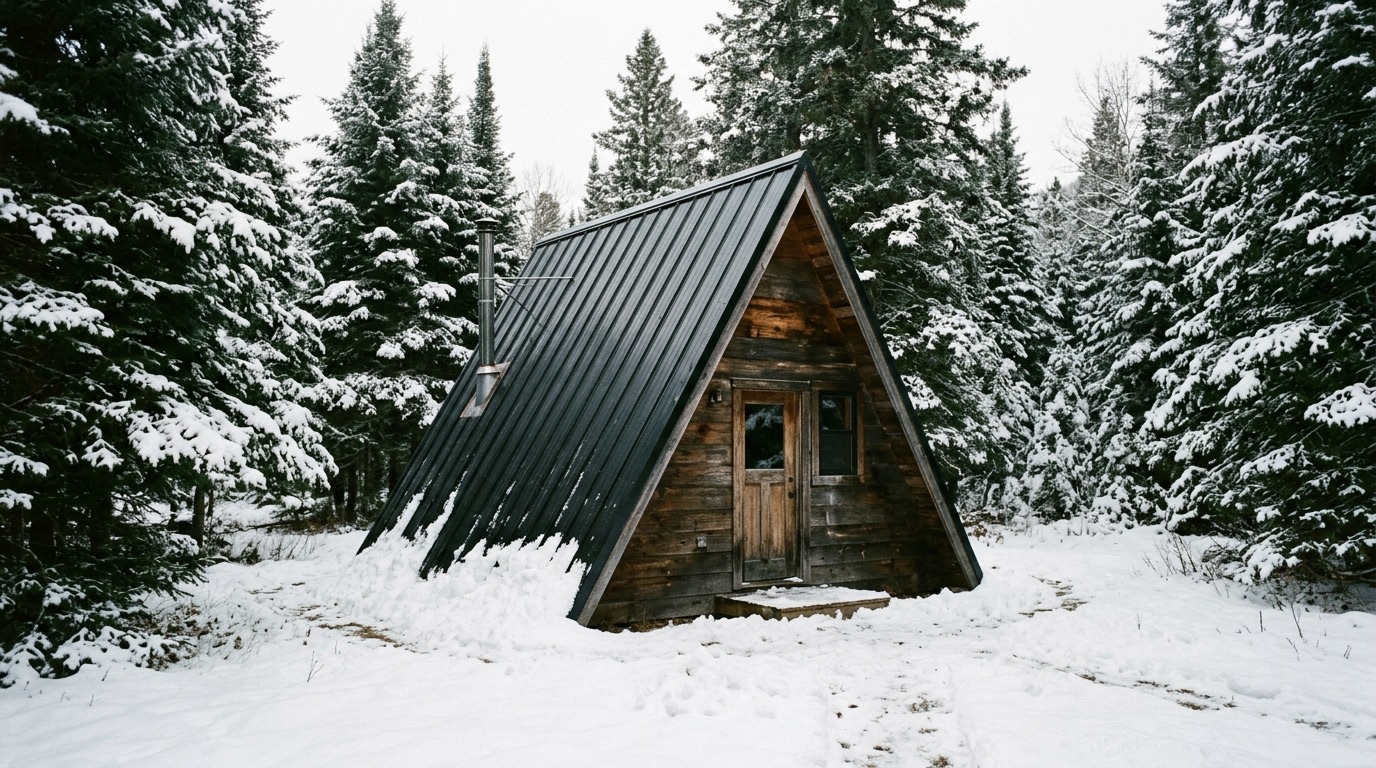
The Fir
- Footprint
- 12 × 24 ft
- Floor area
- 288 sq ft · 26.8 m²
- Beds / baths
- 1 bed · 1 bath
- Loft
- Sleeping loft
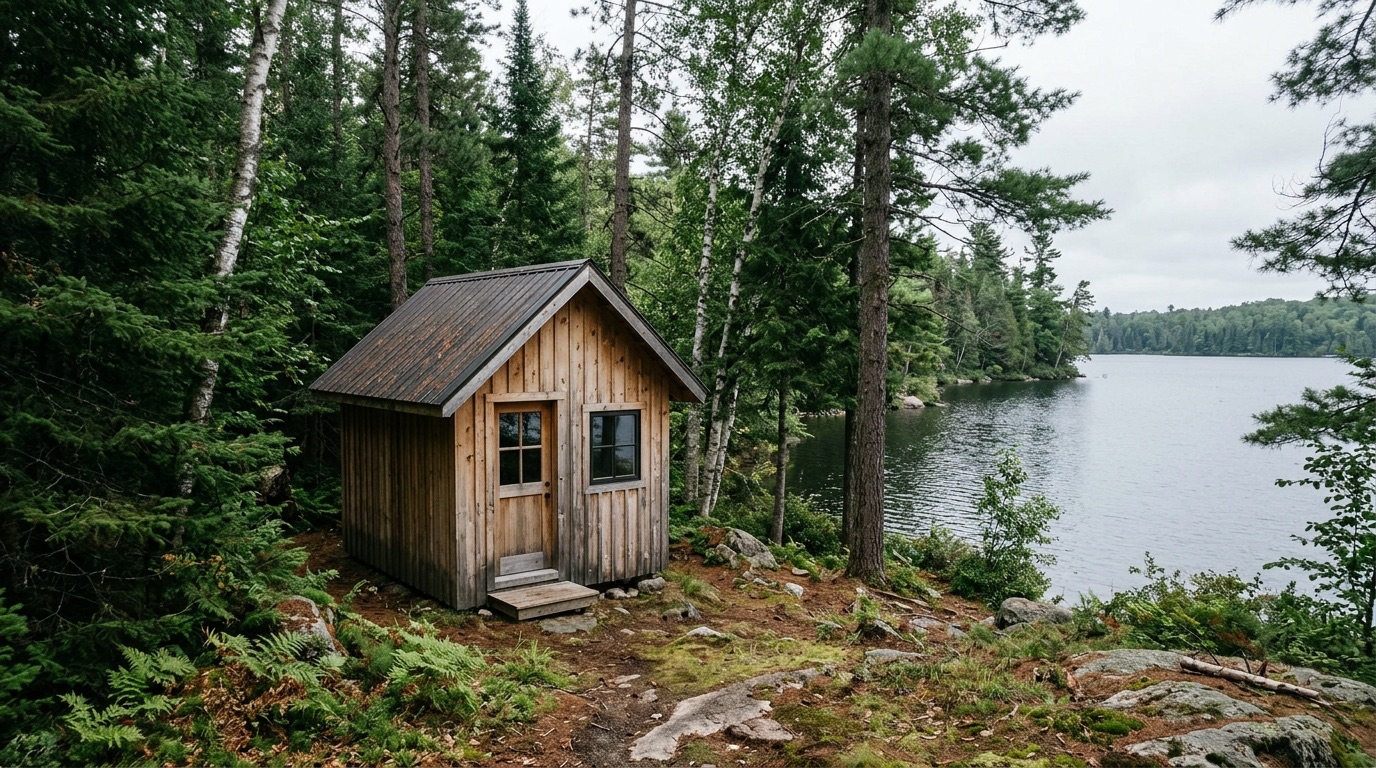
Heat
A wood stove is the usual answer, because the fuel is nearby and it needs no electricity. It also dries boots, boils a kettle and keeps working when everything else has failed.
Size the stove to the room
In a small cabin the risk is too large a stove, not too small a one. A big stove in a small room has to be run damped down to stop the room overheating. A smouldering fire burns dirty, wastes wood and coats the chimney with creosote, which is what chimney fires are made of.
A small stove burning hot is cleaner and safer. Stove makers publish a heating area for each model. Treat it as generous, and if your cabin sits between two sizes and is well insulated, take the smaller one.
Put the stove where its heat can reach the whole space, often near the centre and under the highest part of the ceiling. A chimney that runs straight up through the roof draws better and is easier to clean than one with bends in it.
Clearances and the floor
Every stove needs clear space between it and anything that can burn. A listed stove carries a label giving its tested clearances, and that label, with the maker's manual, governs. An older or unlisted stove has no tested figures, so the common requirement is 36 in (914 mm) to unprotected combustible walls. Approved heat shields can reduce that. The stovepipe has clearances of its own.
Under the stove goes a non-combustible pad. It has to reach beyond the stove, commonly 16 to 18 in (406 to 457 mm) in front of the loading door, where embers fall. Your stove's manual and your local code give the exact figures.
- AStove to wall. A stove with no listing label commonly needs 36 in (914 mm) to anything that burns. A listed stove's label gives its own, usually smaller, figures.
- BStovepipe. The pipe has clearances too. Single-wall pipe needs more room than double-wall.
- CFloor protection. A non-combustible pad under the stove, reaching commonly 16 to 18 in (406 to 457 mm) in front of the loading door.
- DChimney top. At least 3 ft (0.9 m) above the roof where it comes through, and 2 ft (0.6 m) above anything within 10 ft (3.0 m).
The chimney
Use an insulated chimney made for wood stoves wherever it passes through a ceiling or roof, with the maker's own support box and flashing. Outside, the usual rule is called 3-2-10. The top must be at least 3 ft (0.9 m) above the roof where the chimney comes through, and at least 2 ft (0.6 m) higher than any part of the building within 10 ft (3.0 m).
On a steep roof, such as an A-frame, the second part usually decides the height, and the chimney ends up taller than people expect. Tall chimneys need bracing, so allow for it.
Firewood
Green wood is mostly a way of boiling water inside your stove. Cut, split and stack firewood off the ground, with a cover over the top and the sides open to the wind. Most wood needs at least six months to dry and dense hardwoods need a year or more, so the wood for this winter should already be stacked.
Power
List what you will actually run: lights, a phone charger, a water pump, perhaps a fridge. Add it up over a day. That number, not the size of the roof, decides the system.
Add up a day
Electrical use is measured in watt-hours. A device's power in watts, multiplied by the hours it runs, gives the watt-hours it uses. A 9 W bulb left on for 4 hours uses 36 Wh. Do that for everything and add the column.
Here is an example day for a cabin with a small 12 V fridge, lights, a laptop and an internet connection. Your own list will differ. The method will not.
Load | Power × time | Watt-hours a day |
|---|---|---|
12 V compressor fridge | 45 W × 10 h running | 450 |
LED lights | 5 × 9 W × 4 h | 180 |
Laptop | 50 W × 3 h | 150 |
Router and cell booster | 10 W × 8 h | 80 |
Fan | 20 W × 3 h | 60 |
Water pump | 100 W × 0.5 h | 50 |
Two phones | 2 × 15 Wh | 30 |
Total | 1,000 |
The chart shows why the list matters. The fridge uses almost as much as everything else together. Leave it out, or run it on propane, and the whole electrical system can be half the size.
Size the array
Solar panels are rated in watts under full sun. What a site delivers is described in peak sun hours: the number of hours of full-strength sun that a day's light adds up to. Summer figures are high. Size for the worst month you plan to use the cabin, which in much of Canada and the northern United States often means between 1 and 3 peak sun hours in December. Look up the figure for your own location.
Then allow for losses in the wiring, the charge controller, the battery and the inverter, and for dust or snow on the panels. A factor of about 0.7 is a common planning allowance. For the example day, at 2.5 peak sun hours:
1,000 Wh ÷ 2.5 peak sun hours = 400 W of panel, if nothing were lost.
400 W ÷ 0.7 for losses = 571 W.
Round up to what you can buy: 600 W, for example three 200 W panels.
Run the same sum at 5 summer sun hours and the answer is under 300 W. A cabin used only from May to September needs about half the array of one used through the winter.
Size the battery
The battery carries you through the night and through dull days. Decide how many days you want to ride out without sun, which is called autonomy, and how deeply the battery may be discharged. Lithium iron phosphate batteries are commonly used to about 80 per cent of their capacity. Lead-acid batteries last much longer if kept above 50 per cent.
1,000 Wh × 2 days of autonomy = 2,000 Wh to be delivered.
With lithium iron phosphate: 2,000 Wh ÷ 0.8 = 2,500 Wh of battery.
At 24 V that is about 104 amp-hours, so a 24 V, 100 Ah battery is the nearest common size.
With lead-acid: 2,000 Wh ÷ 0.5 = 4,000 Wh of battery for the same job.
Choose a voltage and a battery type
Small systems run at 12 V, which suits lights, pumps and fridges made for boats and camper vans. As a system grows, higher voltage keeps the current down and the cables thinner, so mid-sized systems use 24 V and larger ones 48 V. For the example above, 12 V or 24 V would both work.
Lithium iron phosphate | Lead-acid | |
|---|---|---|
Usable capacity | About 80 per cent | About 50 per cent |
Weight | Light | Heavy |
Upkeep | None | Flooded types need topping up and venting |
Cold | Must not be charged below freezing unless it has a heater | Loses capacity but accepts a charge |
Cost to buy | Higher | Lower |
The cold row matters for a cabin left unheated in winter. Keep a lithium battery inside the insulated shell, or choose one with built-in low-temperature protection.
- APanels. Make direct current whenever light falls on them.
- BCharge controller. Matches the panels to the battery and stops it overcharging.
- CBattery. Stores the day's power for the evening and for dull days.
- DInverter-charger. Turns battery power into household AC, and charges the battery from a generator.
- EGenerator. Fills the gap in a dark week. Runs outdoors only.
- FFuses and disconnects. Each small square is a fuse or breaker, as close to the battery as the wire allows.
A battery can deliver a very large current into a fault, so every connection to it needs a fuse or breaker sized to protect the wire. This is the part of the job to hand to an electrician if you are unsure. Electrical work is covered by codes and often by inspection, off-grid or not.
Generator and propane
A generator fills the gaps in a dark week. An inverter-charger lets it refill the battery in a couple of hours and then be switched off, which is quieter and uses less fuel than running loads from it directly. Run it outdoors and well away from windows and doors, because its exhaust contains carbon monoxide.
Propane can take over cooking and refrigeration so the electrical load stays small. A propane range needs no power at all. A propane fridge needs a level floor, a vent and a carbon monoxide alarm in the room. Keep the cylinders outside.
Water
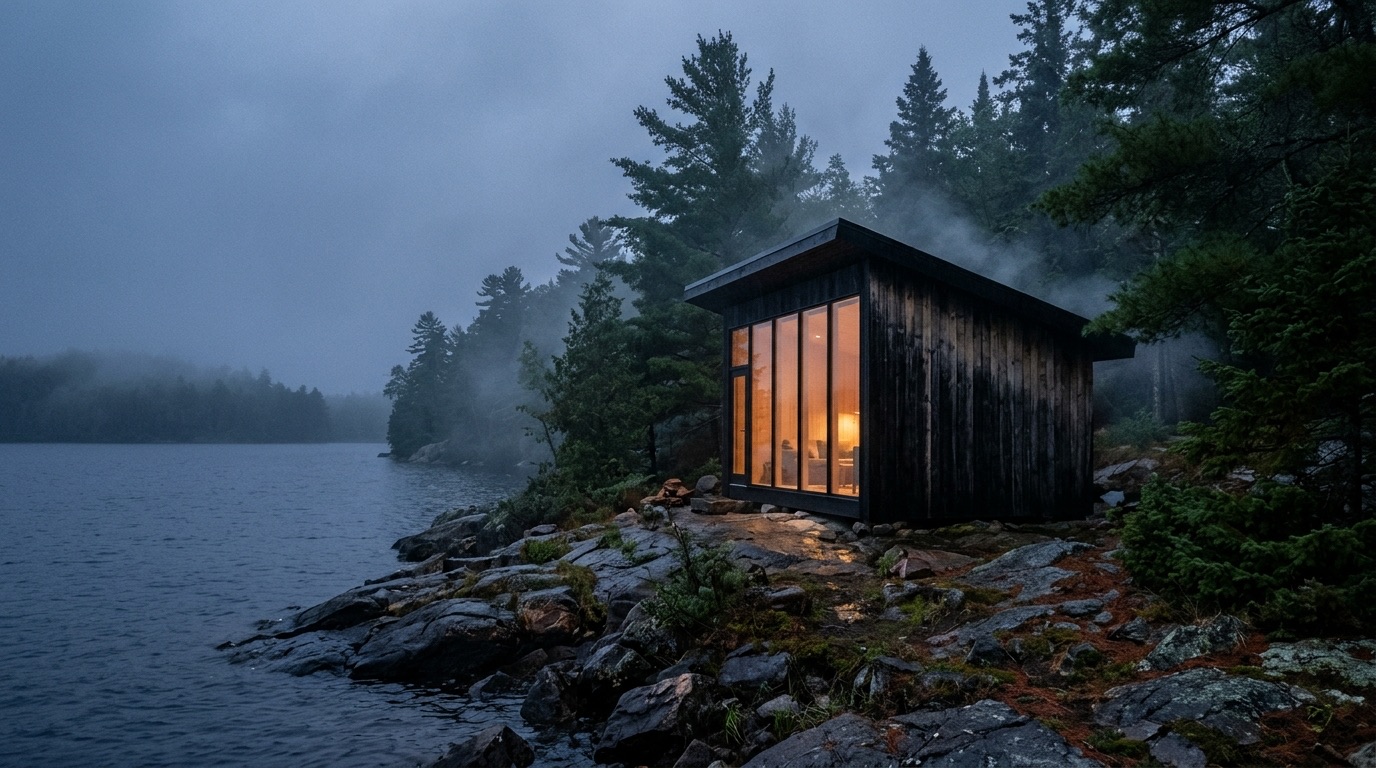
Water comes from a well, a spring, a lake, the roof or a container you carry in. Each has its own treatment needs, and anything you drink should be tested or treated.
Source | What it takes | What to watch |
|---|---|---|
Carried in | Containers and a trip to a tap you trust | Volume. It limits washing more than drinking |
Rain from the roof | Gutters, a first-flush diverter, a covered tank | Roofing material, leaves, dry spells |
Lake or stream | Intake line, pump, filters and disinfection | Always treat surface water. Intakes freeze |
Drilled well | Driller, casing, a pump sized to the depth | Test on completion and then regularly |
Spring | A protected spring box and a line downhill | Flow in late summer. Surface contamination |
Treat what you drink
Clear water is not the same as safe water. Have a new well or spring tested by a laboratory, and again at intervals your health authority recommends. Treat lake, stream and rain water every time.
Treatment works in steps. A sediment filter takes out grit. A carbon filter improves taste and odour. Disinfection, by an ultraviolet lamp or by boiling, deals with bacteria, viruses and parasites. A UV lamp needs clear water to work, which is why the filters come first, and it adds a steady load to the power budget. For a weekend cabin, a gravity filter on the counter and a kettle can do the same job with no power.
- ASource. A well, a lake or the roof. Each one needs testing before you drink from it.
- BStorage. A tank evens out supply and lets a small pump or a slow source keep up.
- CPump. A small 12 V pump pressurises the line. A tank set high can do the same job by gravity.
- DFilters. Sediment first, then carbon for taste and odour.
- EDisinfection. An ultraviolet lamp, or boiling, deals with what filters let through.
- FDrain points. A valve at every low spot, so the system can be emptied before it freezes.
Gravity or a pump
A tank set higher than the tap delivers water with no power. The pressure is gentle, which is fine for a sink and too low for most showers and on-demand water heaters. A small 12 V pump gives household pressure for very little electricity, as the load table shows.
Plan for freezing
In a cold climate, plan for freezing: lines that slope to a drain valve, a pump you can shut down and empty, and nothing left full when you leave. Keep the plumbing short and inside the insulated shell, and group the sink and any shower on one wall so there is one run to drain, not three.
Waste
There are two kinds. Greywater comes from sinks and showers. Toilet waste is called blackwater once it is flushed. A septic system handles both where the site and the rules allow one. A composting toilet removes the second from the question entirely.
Composting toilets and privies
A composting toilet uses no water. Waste falls into a chamber with a dry bulking material such as wood shavings, and a vent pipe carries moisture and odour above the roof. Many models separate liquids from solids, which keeps the chamber drier and the smell down. Small units need emptying often. Larger ones with a chamber below the floor go much longer.
The older answer is a privy, or outhouse: a pit with a small building over it, set away from the cabin and well away from water. It is simple and it works. Where it may be dug and how far it must be from a well, a shoreline or a lot line are set locally.
Greywater
Sink and shower water still has to go somewhere. A cabin with carried water produces very little, and many places allow a simple soakaway pit for it. Others require greywater to go to an approved system. Use a strainer at the sink, keep grease out and choose soaps that break down.
Septic
A flush toilet means a septic system. Waste flows to a buried tank where solids settle and are pumped out every few years. The liquid passes on to a leach field, where perforated pipes let it soak into the soil. The soil does the final treatment, so the system is designed around your soil, usually after a test of how fast water drains through it.
- AComposting chamber. Waste and a dry bulking material, such as wood shavings, break down together.
- BVent. A pipe above the roofline, often with a small fan, carries moisture and odour out.
- CSewer line. Slopes steadily from the cabin to the tank.
- DSludge. Solids settle here and are pumped out every few years.
- ESecond chamber. Clearer liquid passes on. Solids stay behind.
- FLeach field. Perforated pipe in gravel lets the liquid soak into the soil, which finishes the treatment.
Access, contact and safety
A cabin far from a power line is usually far from help as well. Check what phone signal the site has, in the cabin and not only at the road. A cell booster with an outside aerial improves a weak signal. Where there is none, a satellite messenger lets you send a text or call for help from anywhere.
Think about the road in winter. If it is not ploughed, everything arrives by sled or on your back, including propane and drinking water. Keep a first-aid kit, a fire extinguisher and a few days of food and water in the cabin, and tell someone when you expect to be back.
Build it in stages
Nothing says all four systems must be finished in the first year. Many off-grid cabins start simple and grow, and the early stages teach you what you actually use.
Weekends. Wood stove, carried water, a privy or small composting toilet, and battery lanterns or one panel with a small battery for lights and phones.
Longer stays. A solar system sized from a real load list, a rain tank or lake intake with filters, a 12 V pump and a sink that drains properly.
Full time. An array and battery sized for December, a generator for backup, a well if the site allows one, and a septic system or a large composting toilet.
Size every system for the darkest, coldest week you plan to be there. The rest of the year takes care of itself.
Leave room for the later stages when you build. A conduit through the wall, a clear patch of south-facing roof and a spot for a tank cost almost nothing at the framing stage. The guide to building a cabin covers where that stage falls in the build.
The four systems at a glance
System | Simple version | Fuller version | Decide first |
|---|---|---|---|
Heat | Small wood stove | Stove plus propane backup | Stove size and where the chimney goes |
Power | Lanterns and a small panel | Solar array, battery, generator | Your daily watt-hours |
Water | Carried in | Well or lake intake with pump and treatment | The source, and how it drains for winter |
Waste | Composting toilet or privy | Septic system | What local rules allow |
How much does it cost to build a cabin?
Set a floor area and a finish level to get a working range before you choose a plan.
Off-grid cabin questions
How much does it cost to take a cabin off-grid?
It depends on how much power and plumbing you want. A stove, a few panels and carried water is a small budget. A solar system sized for winter, a drilled well and a septic system is a large one, and the well and septic are usually the biggest parts of it.
How many solar panels does an off-grid cabin need?
Add up your daily use in watt-hours, divide by the peak sun hours in the darkest month you will be there, then divide by about 0.7 for losses. The example in this guide, 1,000 Wh a day at 2.5 sun hours, comes to about 600 W of panels. A cabin without a fridge can need less than half that.
Can I live off-grid all year?
Yes, if heat, water and power are sized for winter, which is the hardest season for all three. That means a well-insulated shell, an array and battery sized for December, water lines that cannot freeze and a road you can get in on.
Do I need permission to go off-grid?
Being off-grid does not exempt a building from local rules. The cabin itself, the wood stove, the wiring and above all septic systems and wells are usually regulated. Ask your building department and health authority before you design the systems.
What size cabin is best off-grid?
A small one. Less floor area means less to heat, light and build far from a road. A one-room plan with a sleeping loft is the usual starting point, because the loft adds beds without adding floor to heat.
Is a composting toilet allowed in place of septic?
In many places yes, sometimes only with an approved model, and you will still need an approved way to deal with greywater. Some areas require a septic system for any building with plumbing. The rule is local, so check before you buy.
What should run on propane and what on electricity?
Anything that makes heat is expensive to run from a battery, so cooking and water heating usually go to propane or the wood stove. Lights, electronics and pumps suit solar well. A fridge can go either way: electric adds a large load, propane adds a fuel to carry in.